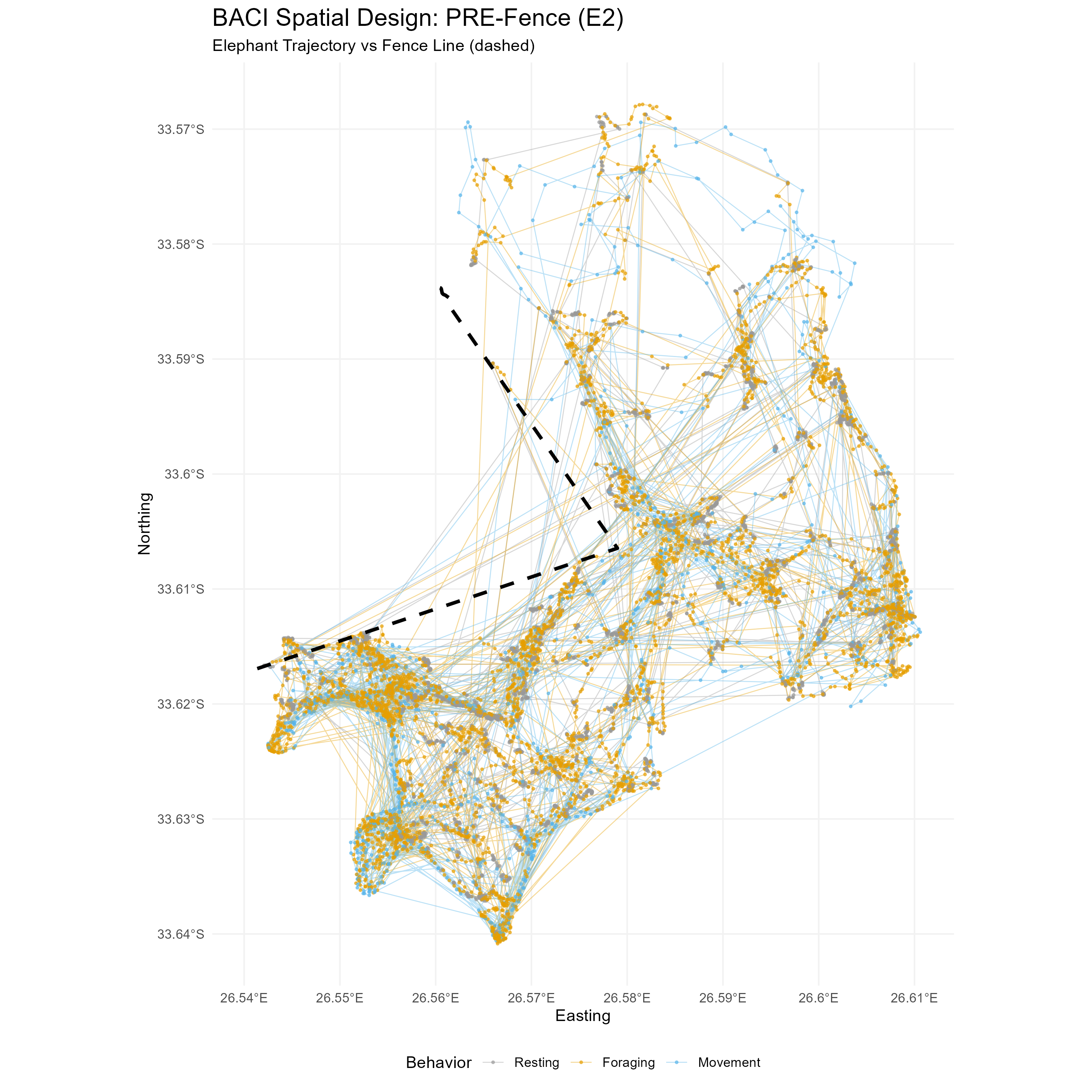
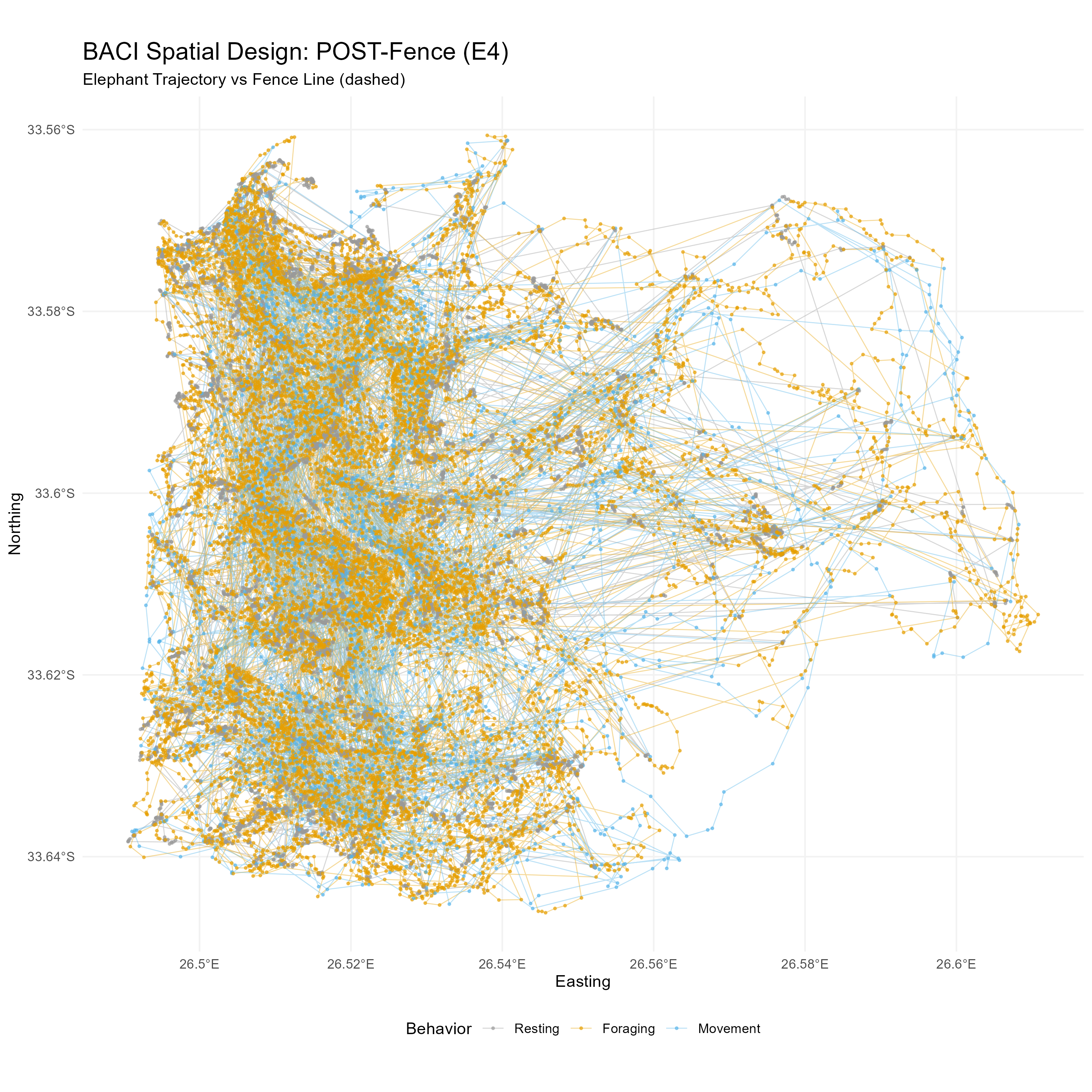
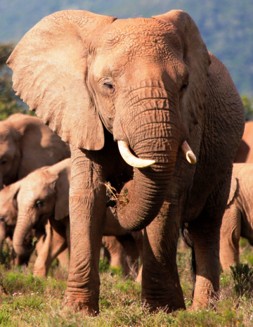
Here we explore behavioral trajectories, habitat selection patterns, and movement dynamics of 6 elephants across a natural BACI (Before-After Control-Impact) study design using advanced HMM (Hidden Markov Models) and RSF (Resource Selection Function) models.
Before-After-Control-Impact study examining elephant behavior across fence removal periods: Pre, Interim, and Post phases.
Hierarchical Hidden Markov Models (HMM) classify trajectories into binary states: Sleeping, Low-energy, Foraging, and Movement, with spatial interactions (Bounce).
Resource Selection Functions model habitat selection intensity, revealing behavioral-specific landscape preferences.
Chronological progression of the BACI experimental design
Initial GPS collar deployment and baseline behavioral monitoring within fenced management zones.
Internal boundary between Kariega West and Harvestvale removed, initiating the interim transition phase.
Initial behavioral adaptation and exploratory movement into previously inaccessible landscape segments.
Stable utilization of the unified landscape and establishment of novel behavioral-habitat selection patterns.
A multi-scale investigation into elephant behavioral shifts and spatial constraints following landscape-level management interventions.
How do African elephants allocate time among movement, foraging, sleeping, and low-energy behavioral states as inferred from GPS collar data?
How does the spatial distribution of behavioral states vary across the landscape to identify core areas and movement corridors?
How do activity budgets and spatial selection differ among elephants by sex and social grouping?
Do elephants exhibit persistent movement constraints consonant with a "ghost fence" effect following physical removal?
Watch elephant movements unfold over time with smooth animations, behavioral color coding, and synchronized multi-elephant views.
Explore →
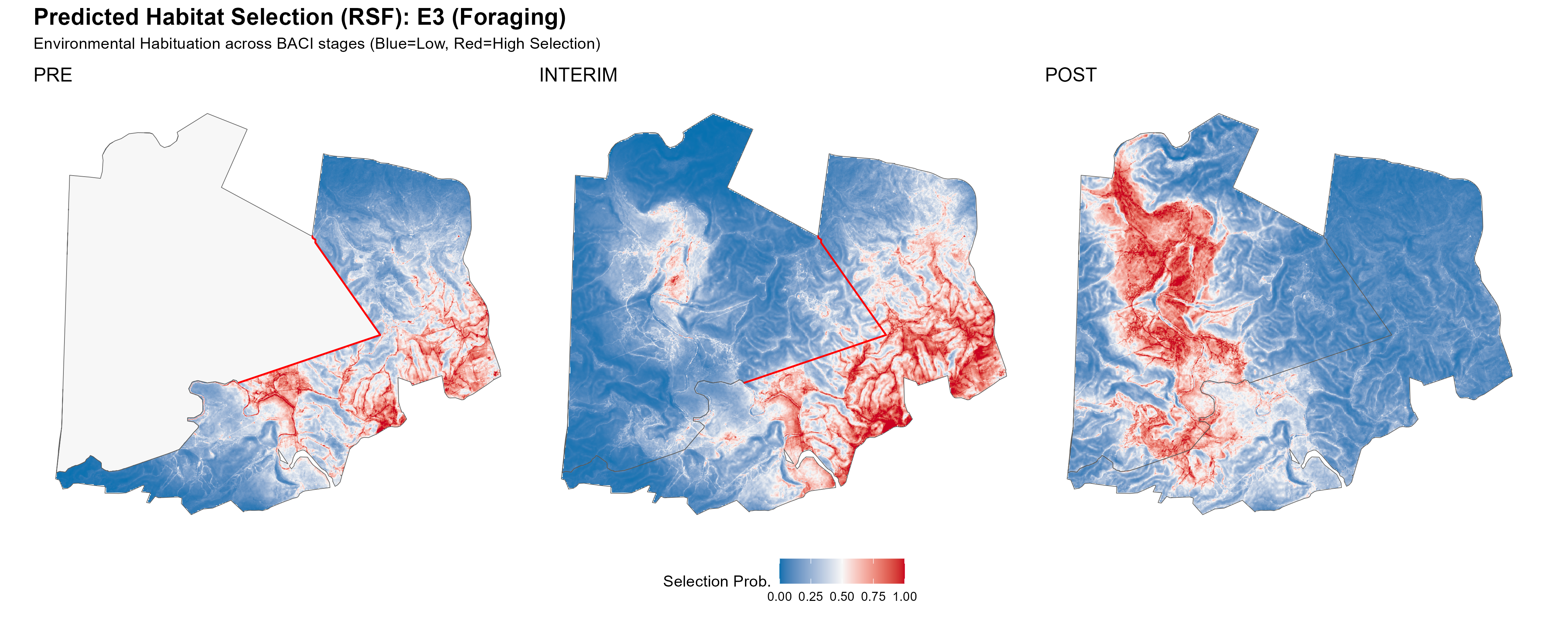
Toggle habitat selection intensity overlays with adjustable opacity to compare predicted vs. realized occupancy patterns.
Compare →
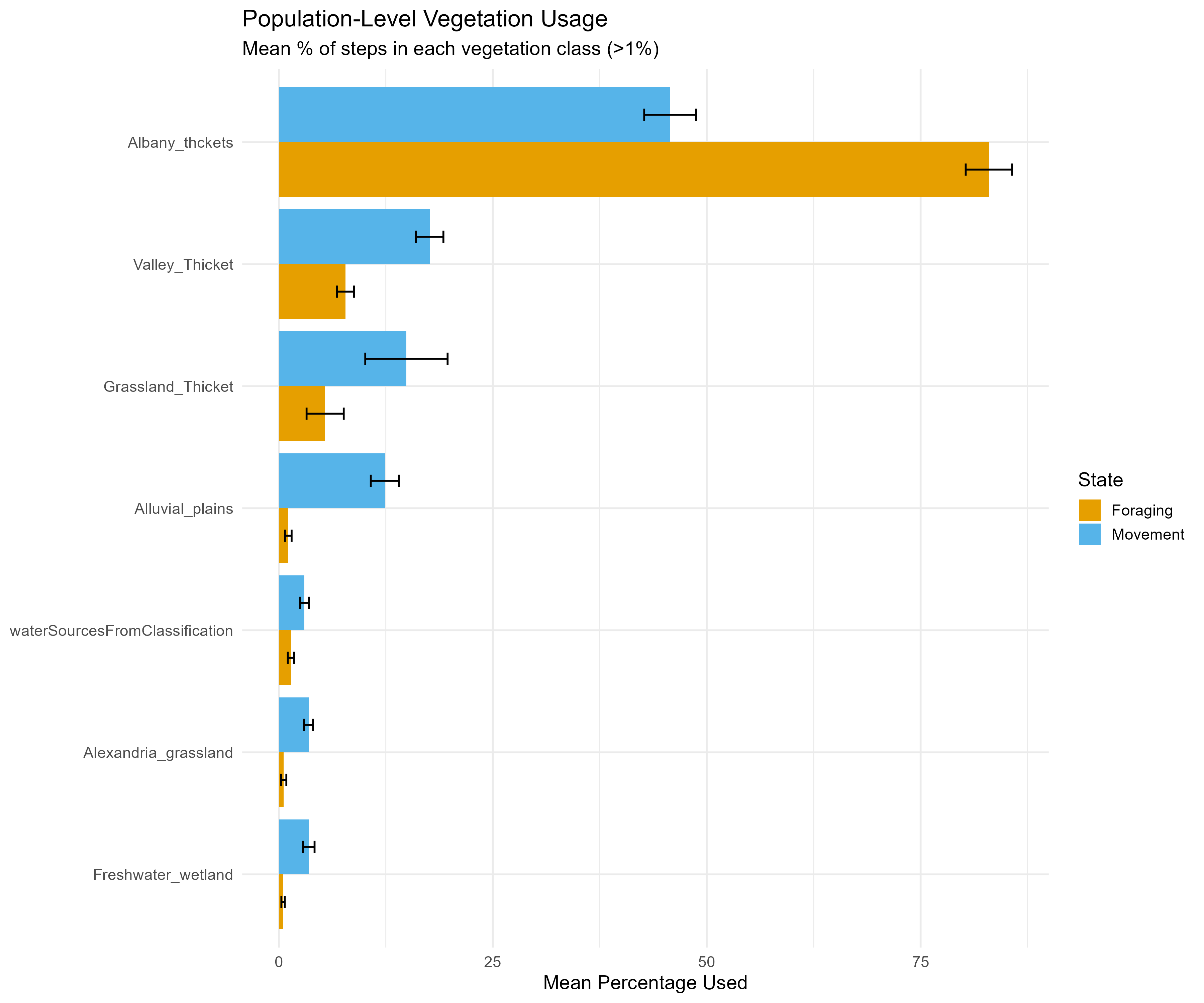
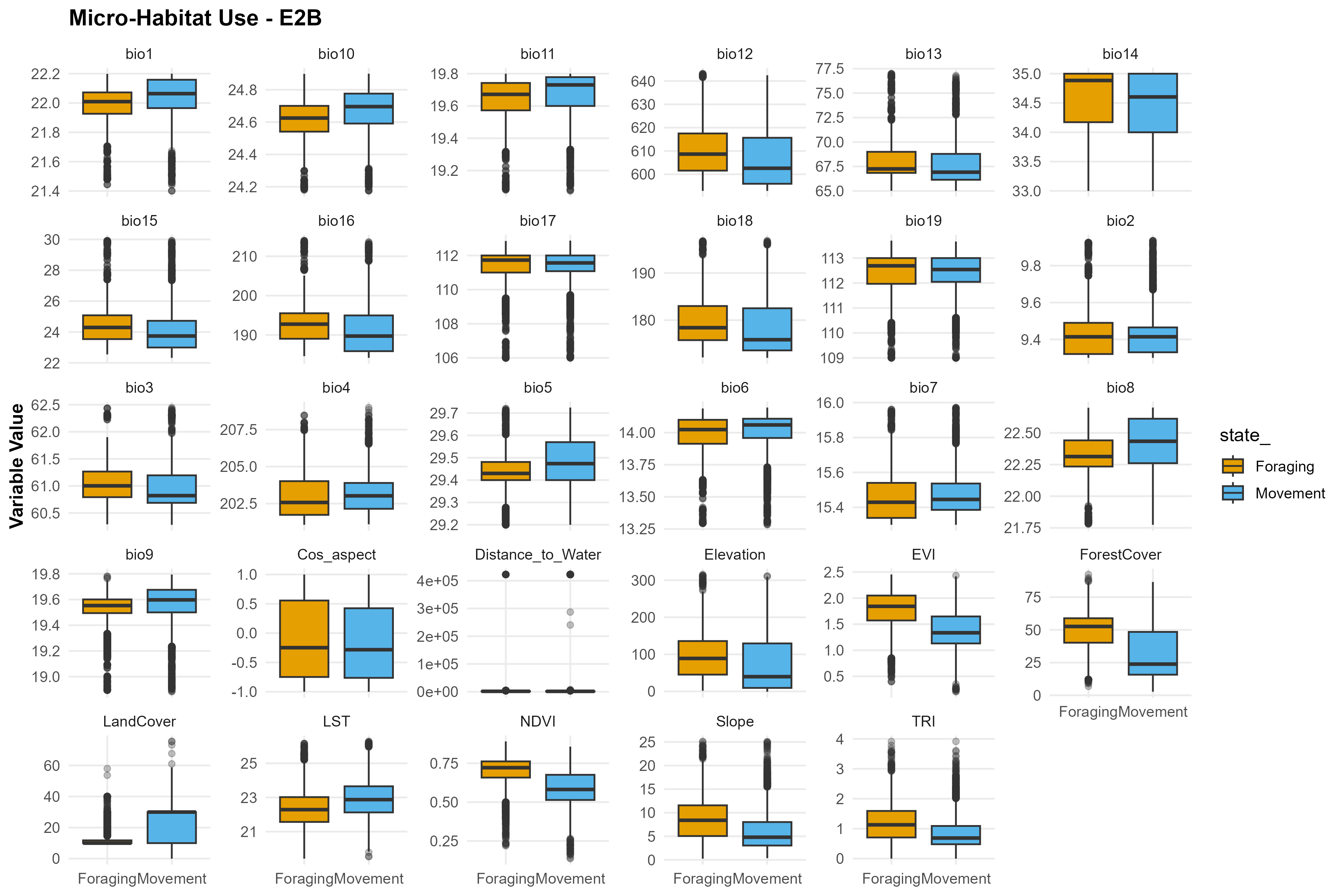
View behavioral state distributions, movement metrics, and time budgets that update as you scrub through the timeline.
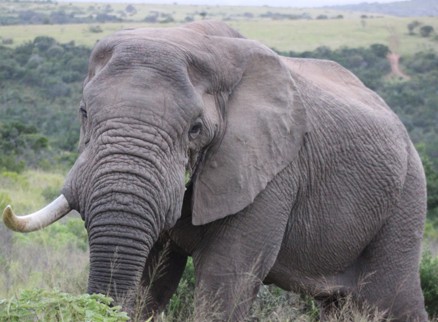
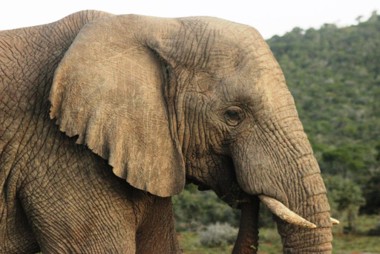
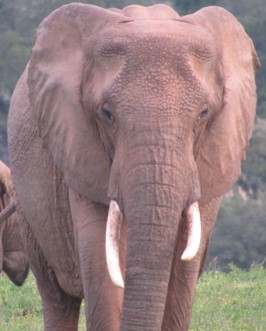
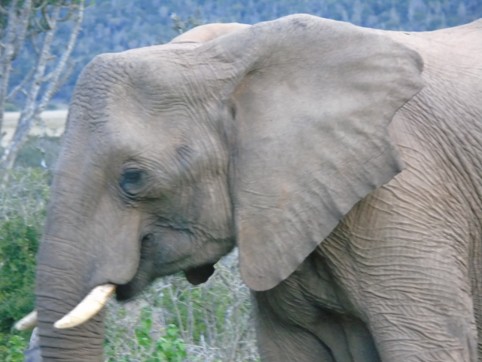
Analyze →Six elephants tracked across the BACI study periods, each with unique movement patterns and behavioral adaptations
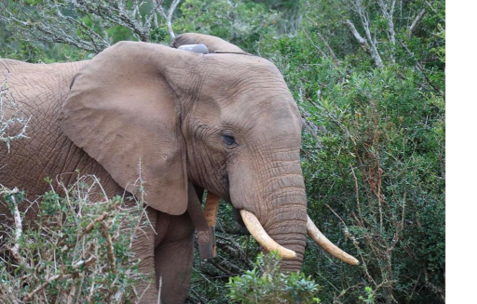
Ecological baseline in the Kariega West (KW) exclusion zone, demonstrating typical daily periodicity in foraging and maintenance behavior.

Pre and interim period data with stable movement patterns within established territory.

Pre and interim period data providing baseline behavioral metrics and movement patterns.

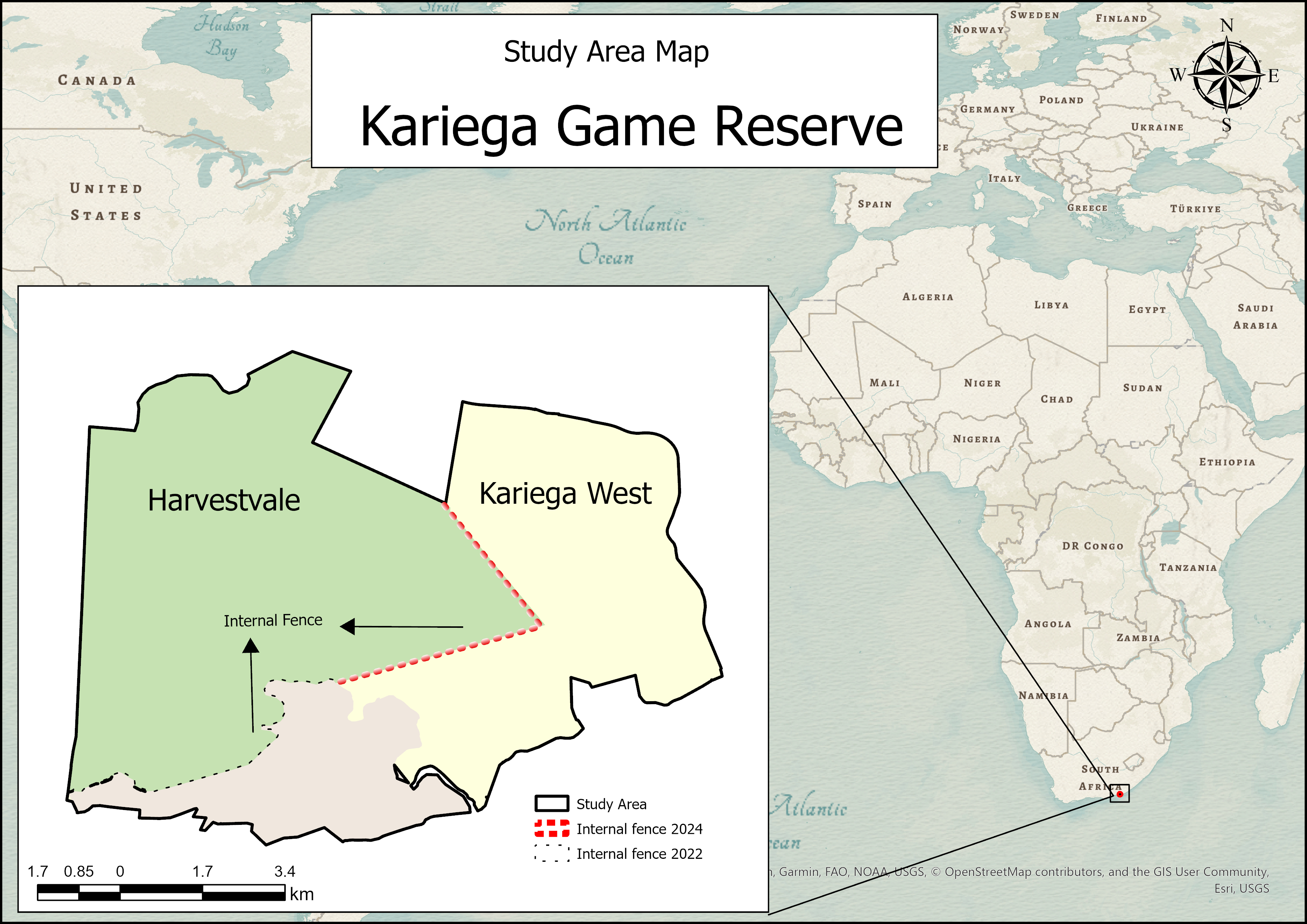
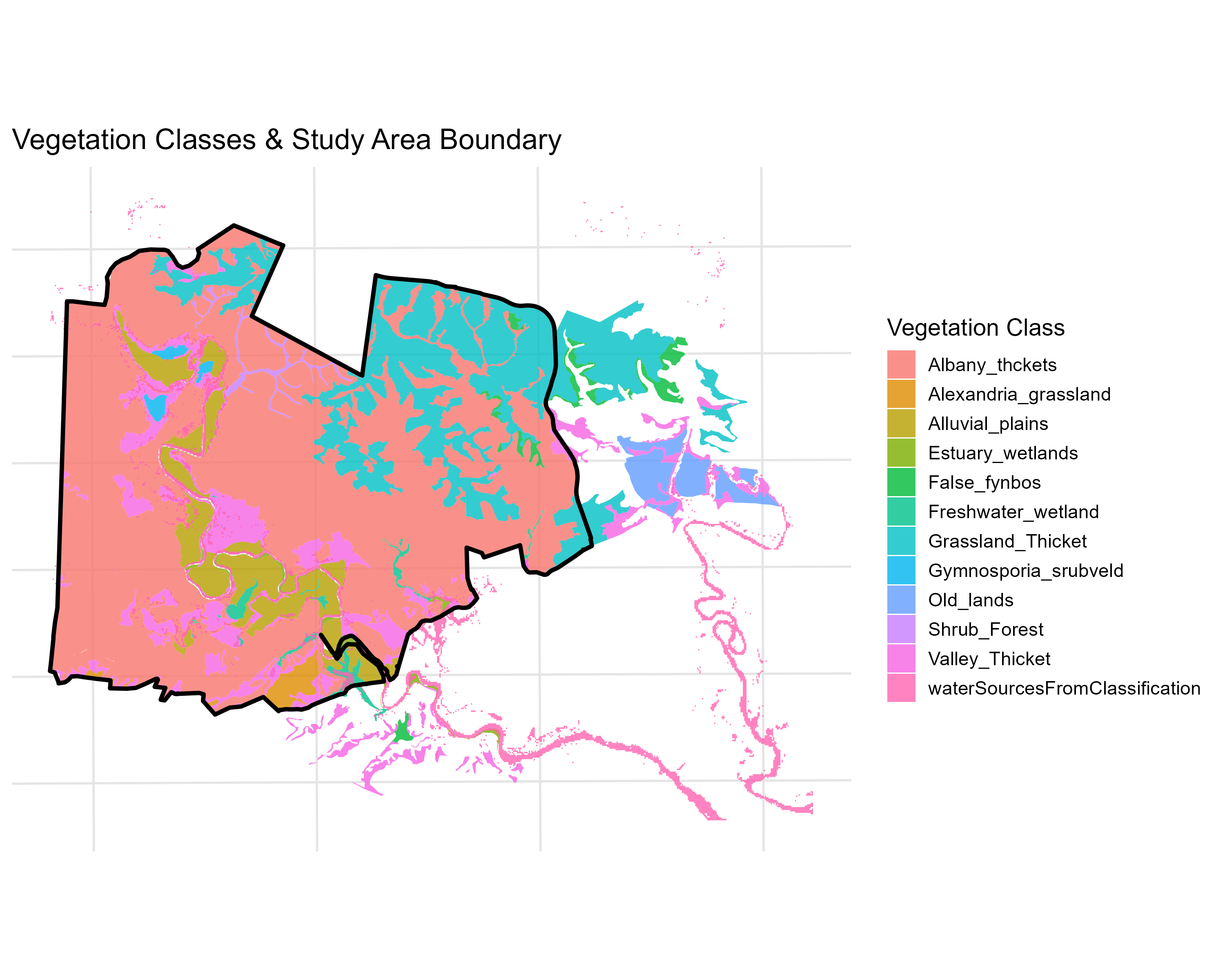
The Kariega Game Reserve, located in the Eastern Cape province of South Africa, is a premier private wildlife conservancy spanning approximately 10,000 hectares (115 km²) along the Bushmans River. The reserve is dominated by dense, woody, and thorny semi-succulent vegetation characteristic of the Albany Thicket biome.
Kariega supports a diverse assemblage of wildlife, including African elephant (Loxodonta africana), giraffe (Giraffa camelopardalis), cheetah (Acinonyx jubatus), white and black rhinoceros (Ceratotherium simum and Diceros bicornis), ostrich (Struthio camelus), and numerous avian and reptile species.
Initially, the elephant population (75 individuals) was divided by an internal fence into Kariega West (KW; 2,792 ha; 55 elephants) and Harvestvale (HV; 4,369 ha; 20 elephants). Fence removal in 2024 created a contiguous 8,192 ha landscape accessible to the entire population.

Full BACI dataset showing dramatic range expansion and habitat exploration post-fence removal.

Complete temporal coverage with notable behavioral shifts and increased movement range.

Full dataset revealing gradual habitat exploration and adaptation to novel landscape features.